
Insights
Articles
22 December 2025
5 min read
How Automation & AI Are Replacing Elves in 2025
Praise Ohans
Author
Introduction
Santa’s workshop was once characterized by rigorous effort, with elves spending long hours on repetitive tasks just to keep up with holiday demand. The reality is changing today. In 2025, holiday shopping is being powered by AI systems, and automation software. Intelligent technology is now behind how products are designed and how they’re packaged and delivered.
With AI, retailers can now predict demand before it rises. Little wonder why factories rely on it to adjust production in real time. Also, logistics companies depend on it to deliver packages faster and save valuable time. Times are changing. What used to require massive human coordination is now handled by algorithms that learn, and adapt with every cycle.
The advent of AI raises a rather pertinent question on if these machines simply support human workers, or if they are now the workforce themselves. The answer sits somewhere in between, and understanding that balance is key to how products are made, and delivered today.
The Smart Factory Era
When you hear the word “factory”, it is normal to think about a building where goods are manufactured using machines. However, the definition has now transcended beyond that to becoming intelligent environments powered by Physical AI, where systems can sense, decide, and act without waiting for human input. Modern manufacturing now runs on real-time data pulled from sensors, supply chains, and customer demand signals.
AI powered manufacturing systems have evolved beyond simple repetitive tasks to collaborating with humans, and optimizing workflows seamlessly. They find relevance in monitoring equipment health, predicting break down before they happen, and reducing downtime that used to cost companies millions. The perks are invaluable, given that we are in a world where labour shortages, rising costs, and unpredictable demand have become the norm.
Smart factories have become the foundation of the evolution happening across supply chains. With smart production, distribution becomes faster, and businesses gain the flexibility to respond instantly to market pressure.
How AI Is Reinventing Toy Production
The toy industry is one of the clearest examples of how AI is transforming modern production. Through smart automation, a toy manufacturing company automated 68 global processes, saving over 11,000 hours as a result. Asides the numbers, the impact is massive. Skilled toy engineers that were once stuck at handling repetitive administrative tasks can now spend time on design, experimentation, and innovation.
In factories, toys are now being made using advanced manufacturing technologies. AI-driven automation works alongside 3D printing and IoT-enabled systems to manage production with far greater accuracy and consistency than manual processes. Semi-automatic roto molding machines and precision manufacturing equipment now handle intricate designs better than what the human hands can carve. With built-in temperature control, efficient cooling systems, and flexible heating options, these machines offer versatility at a large scale.
The global toy market is projected to reach $141.16 billion in 2026, with major companies like LEGO responding by investing heavily in automated and sustainable production systems. In 2023 alone, LEGO increased its environmental spending by 60% while maintaining production efficiency through advanced automation. These investments allow manufacturers to experiment with new materials, explore biomimicry-inspired designs, and meet sustainability goals.
Warehouse Robots
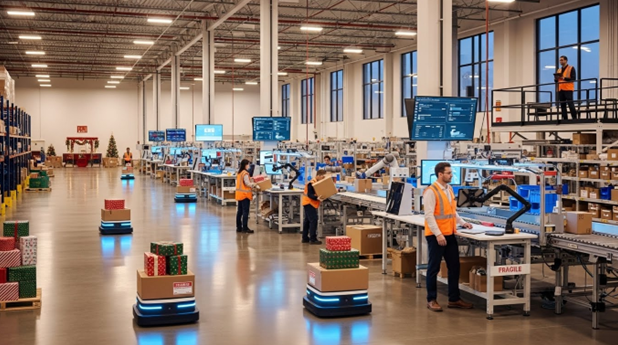
Logistics and warehousing have become the most automated segments of the manufacturing process. E-commerce volumes keep rising, and as a result warehouses face intense pressure to process large numbers of orders accurately and within a short period. WIth AI-powered warehouse robots, this challenge is properly addressed.
As of June 2025, Amazon operates over one million robots across its global warehouse. Robotic arms like Sparrow can visually identify and pick different products, while systems such as Cardinal use computer vision to sort packed boxes at a speed and accuracy level that humans can't match.
This shift is not limited to tech giants alone. Locus Robotics reports deployments across more than 350 sites worldwide, where autonomous mobile robots work alongside human staff. This collaboration helps to increase productivity and reduce physical strain on workers. Fewer people are needed to move the same volume of goods, because robots take over the heavy, and repetitive tasks. This helps to scale operations during peak holiday periods without the need for increase in labour.
The MIT-founded Pickle Robot Company has developed one-armed robots capable of independently unloading trailers and lifting boxes weighing up to 50 pounds. The impact on operations is profound. Warehouses using AI-driven automation report 30 to 40% reductions in travel time for materials compared to traditional setups. Labor costs for routine tasks have dropped significantly as workers are reassigned to higher-value roles such as supervision.
Humans, Cobots, and Job Demand
A lot has been said about automation. But then, it needs to be said that automation does change jobs. As mentioned earlier, the advent of robots does not completely erase the need for human workers. Rather than completely replacing humans, they are designed as collaborative robots, working alongside humans.
Unlike traditional industrial robots requiring extensive programming, many modern collaborative robots/cobots can be deployed with little or no coding. Cobots are designed to work directly alongside humans. They use sensors, real-time feedback, and lightweight designs to handle repetitive, physically demanding tasks while humans manage decisions, oversight, and problem-solving. In factories and warehouses, this model is already becoming a popular choice, with the collaborative robot market projected to grow from $1.26 billion in 2024 to $3.38 billion by 2030.
The fact that cobots work smartly alongside humans doesn’t change the fact that displacement is happening. Automation and AI are already displacing tens of millions of roles globally, particularly in customer service, data entry, retail operations, and routine manufacturing work. At the same time, new roles are opening up in robotics maintenance, AI systems oversight, data operations, logistics optimization, and digital manufacturing. The issue is not about job availability, but about job readiness.
Conclusion
Santa’s workshop has evolved through automation and AI to reshape how gifts are made and delivered. Factories now utilize AI and automation to make logistics systems react in real time. But none of this runs without human oversight. Human roles may have shifted due to the advent of AI, but their involvement stays central.
As the holiday season rolls in and packages arrive at a rapid rate, it is worth remembering that behind every automated system is a human who built it, trained it, or manages it. The future of work will not be decided by how advanced machines become, but by how well people are prepared to work with them.
TAGS:


Build what matters, with Gozade
Let's Talk

Gozade
3rd Floor, 86-90 Paul Street, London, England, United Kingdom, EC2A 4NE
HOUSE NO. 33C, ROAD 2, IKOTA VILLA ESTATE, IKOTA, LEKKI, LAGOS
+2349032770671, +2349032942619
Gozade builds smart digital solutions that help businesses grow and scale with confidence.